
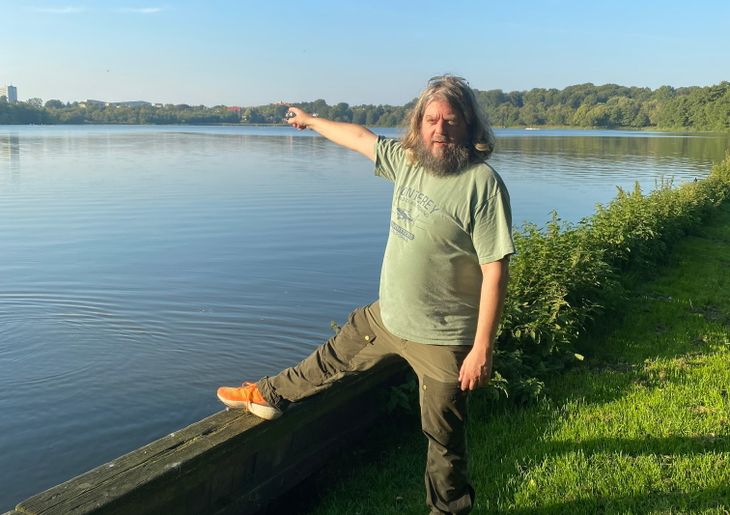
An intimate conversation with Anders Lund Madsen on a bench by our local lake and how not taking yourself too seriously makes life more enjoyable
You’re probably wondering one of two things: how the hell did I manage to interview Anders Lund Madsen, or who the hell is Anders Lund Madsen? My guess is that you’re asking the latter – in which case, I can say with 100% confidence that you’re not Danish. Everyone in Denmark knows who Anders is. He’s a funny, down-to-earth, and genuinely intelligent journalist who has blessed Danish television since before I was born in 2000. Think Graham Norton but funnier (sorry Graham!) and more pensive.
As I walk to the bench where we’ve arranged to meet, I give Anders a wave. I grew up watching him on TV, and now we’re drinking ice cold elderflower cordial together by Lyngby lake. Not only do we dive into his career, but we also talk about the importance of not taking yourself too seriously in this anxiety-inducing world, which I think everyone should read about – even if you’re still wondering who Anders is.
‘I couldn’t see myself as anything, so I applied to everything’
For university, Anders applied to everything that was difficult to get into, including law, natural sciences, and midwifery. ‘I was so stupid that I thought just because it was difficult meant that it was fun,’ he tells me in a tone that seems to say: ‘it’s kind of funny but also kind of tragic’. But I don’t think young Anders was ‘stupid’. Like many of us, Anders wanted to satisfy his parents, especially his dad. His dad had worked his way up the social ladder and became an academic after a humble upbringing in the Danish countryside; he wanted his sons to become academics too. Luckily for Anders, his brother Peter was passionate about medicine and eventually became a doctor, which ‘took off some of the pressure, so they were a bit more relaxed.’ I tell Anders that I was happy to hear that his brother’s success impacted Anders positively instead of creating additional pressure. My own brother, I explained to him, was kind of like Peter. He had gotten into Physics at Oxford University when I was 15, so I felt like I’d be a failure if I didn’t also get into Oxford when I applied three years later. ‘Shit,’ Anders softly exclaims. ‘Good thing I didn’t think that way!’ I hope this serves as a good reminder to not compare yourself to others, not even your own siblings, because we’re each running our own unique race.
‘I was good at writing but really scared to talk to people – as in, really scared’
In his early 20s, Anders had written a book review which got published in the popular Danish tabloid Ekstra Bladet. ‘I was insanely proud – really, excessively proud. And I liked that feeling,’ he says. That feeling sparked his career in journalism, but it wasn’t just sunshine and rainbows from there. Anders was terrified to talk to people and, as he puts it, ‘it’s not that smart to have social anxiety when you’re going to be a journalist.’ Initially, he avoided calling, approaching, and talking to people at all costs. But when he eventually started working for Ekstra Bladet, he was thrown into the deep end and repeatedly forced to do the anxiety-inducing part of the job. It’s not that he didn’t like conversing with others, but more that he was too self-conscious to enjoy it. ‘It’s extremely interesting to talk to people, but I only know how to do it when I know what to talk to them about,’ he explains. Eventually, Anders began to see his occupation as the perfect excuse to boldly approach people. He’s not doing it as Anders but rather as Anders-the-journalist.
Funny or serious? Finding the right balance
Anders is generally seen as a funny guy in Denmark. He can even make my Chinese mom laugh, and she’s usually not a huge fan of Danish humour. But Anders is also a pensive person who’s interested in spreading awareness about taboo topics like mental health and death. He says he ‘tried to make it serious one half of the time and funny the other half of the time.’ Using an analogy to agriculture, Anders compares his work to how farmers don’t grow, for example, corn one year after the other to avoid exhausting the earth. He admits that he thinks it’s ‘most fun to do something that’s entertaining,’ which does sound pretty logical, but he nevertheless also says that ‘it doesn’t work if there isn’t something to ground yourself in once in a while’.
I ask how he balances being serious with also being funny – does he change his interview approach at all or is he just himself? With conviction, Anders says that the latter is the easiest. ‘It’s very complex, socially, if you have different identities, right? If you’re already struggling a bit socially, then multiply that by 10 if you’re going to play with different personalities.’ It sounds like just be yourself but with a twist. Instead of the classic just be yourself because everyone else is taken, Anders gives an additional incentive: be yourself because it’s too difficult not to.
With that being said, your self doesn’t and probably shouldn’t always stay rigid. Different situations call for different levels and nuances of sensitivity to other people’s feelings. Situational awareness is essential to how Anders can sometimes be funny and serious at the same time. While he admits that ‘inappropriate humour in wrong situations is just stupid’ and that there are many things he wouldn’t do if someone is enormously sad, he also believes that ‘you can still use humour regardless of how ridiculously sorrowful a situation is.’ If it’s done right, of course. Then, Anders says something that I hadn’t really heard before, though it seems so obvious: ‘all people in the whole universe want to get into a better mood.’ Okay, maybe the whole universe is an exaggeration, but I still agree with him – if you’re sad, you want to feel happier. Anders is one of those people who isn’t afraid to try and cheer up people who are really (and really) sad. He thinks no one is too proud or stuck-up to laugh at something if it’s genuinely funny.
Anders then recalls a young man he’d once met who had every reason not to laugh but still did. In one of his TV programmes, Anders follows a few patients at a hospice to help shed light on what happens before and after people die. One such patient was a 24-year-old guy who had terminal leukaemia. Both his parents were doctors who felt extra helpless, and his goal was to live until his girlfriend’s birthday. Anders rightly summarises the situation as ‘fucked up, really.’ They’re sat in his room, quietly watching Aftenshowet (‘The Evening Show’), which is a popular, casual news programme in Denmark. ‘There wasn’t that much to say,’ Anders tells me, so they were just talking about how ridiculous the show is and how unimportant it is. ‘Especially when you only have like 8 TV-nights left.’ And then, Anders said something that was half-funny but also half-tragic: ‘That’s at least something you can look forward to being rid of – bad television.’ Like Anders said, ‘it’s funny but simultaneously not funny and incredibly tragic, because it implies that he’s 24 years old and about to die. But it’s possible to make someone laugh even in that moment.’ And he did indeed laugh. It’s not because you should make someone laugh when they’re unhappy, but the way Anders sees it: ‘regardless of how miserable something is, you can always see parts of it as absurd – and sometimes, the absurd is funny.’

A career of not taking things too seriously
Anders’ career is full of moments that some may describe as embarrassing.[1] But embarrassing to whom? In an old interview, he once said that he ‘institutionalised losing face’ and made it his livelihood. It doesn’t seem like Anders is embarrassed. In fact, in the same interview, he advised people to ‘make a career out of not taking things too seriously. It gives a lot of peace.’[2] I ask him, ten years later, what kind of peace was he referring to? At first, his answer sounds almost philosophical, and you have to see it in Danish for it to make more sense: ‘ro som i fravær af uro.’ More directly translated, this means ‘peace as in the absence of not-peace.’ But ‘uro’ also means unrest or turmoil, and Anders still believes that not taking yourself too seriously removes feelings of unrest to the point that ‘there is no trouble.’
‘The good thing about not being taken too seriously,’ Anders continues, ‘is that you won’t have as many expectations weighing you down.’ When his brother, for example, became a doctor at the age of 29, he set the bar for himself high. ‘It probably makes it more exciting but not easier for him,’ Anders reflects. ‘That’s why it can be really smart to lose face severely.’
When he was young, Anders was preoccupied with ‘doing things right’. He spent a lot of his time guessing what people wanted, as well as how and when they wanted it. ‘It was very much about not trying to disappoint people,’ he says. But he realised that he would ‘never really be good enough because [he] hasn’t succeeded in figuring out what people want.’ I don’t think any of us know exactly what other people want, so we’d all be doomed to fail if we lived our lives according to others and their needs. Instead, Anders figured out that the more ‘idiotic’ his behaviour was, the less people expected of him – and the more he could relax.
‘As long as you don’t see yourself as insanely crucial for the world’s survival or development, then everything becomes a bit lighter.’
That really stuck with me. There’s something relieving but also somewhat disappointing about realising this. It’s not that I saw myself as being ‘insanely crucial’ for the world, but I’ve sometimes put too much weight into my decisions, especially in stressful situations. Of course, some people have to be more serious than others, and we’ll have to be serious at different points in our lives, but I know I’m not the only one who has overhyped their own importance, in the sense that it feels like the world depends on you. If you relate, you can join me in this humbling and liberating realisation that it’s ‘important not to take yourself too seriously,’ as Anders says. He believes that this will make it ‘much more enjoyable and less stressful to exist.’
That’s not to say that Anders has it all figured out. I ask him if he feels completely at peace and liberated, and he’s not afraid to admit: ‘No, no, no, I’m not calm at all.’ There’s still a way to go, and he hasn’t reached some ‘meditative, karmic peace where everything just works.’ But there are ‘small moments,' he says.
And even if they’re small, we should still appreciate such moments of peace and inner calmness. I know that I felt calm when I interviewed Anders, despite being nervous at first. He was reassuring and realistic about his experiences as well as his advice. I hope you’ve been entertained and inspired, even if you’re still wondering who he is.
This interview was conducted in Danish but has been translated into English, with the approval of Anders Lund Madsen.
[1] For example, in the 1996 Olympics when he asked the US basketball ‘dream’ team why you get two points for a basket.
[2] From the interview https://www.magasinetkbh.dk/indhold/det-er-en-del-af-planen
Author
